Maria Vasilakis DMD

617-782-2267
comprehensive dental care

Random header image... Refresh for more!

Category — News

Dental Xrays in the news… here are the facts

If you have tuned in to many sources of media this week, you may have heard news on recent studies linking dental Xrays to benign brain tumors. 

The research was confusing and poorly executed, “They found a small risk (from) a pair of bitewings, but not a full mouth series, which is multiple bitewings. That inconsistency is impossible to understand to me,” said Dr. Alan Lurie, president of the American Academy of Oral and Maxillofacial Radiology

The statement added, “The ADA’s long-standing position is that dentists should order dental X-rays for patients only when necessary for diagnosis and treatment. Since 1989, the ADA has published recommendations to help dentists ensure that radiation exposure is as low as reasonably achievable.”

Patients should be concerned whenever they are exposed to radiation, but it’s important to emphasize that this concern should not mean that we shouldn’t get X-rays at all.

The take home message is that ”while dental X-rays are an important tool in well selected patients, efforts to moderate exposure to (ionizing radiation) to the head is likely to be of benefit to patients and health care providers alike.”  The risk of missing easily diagnosable dental diseases when treatable in early stages outweighs the small exposure to radiation, especially with digital (minimal dosages) radiography as we provide at Dr Vasilakis’ office.

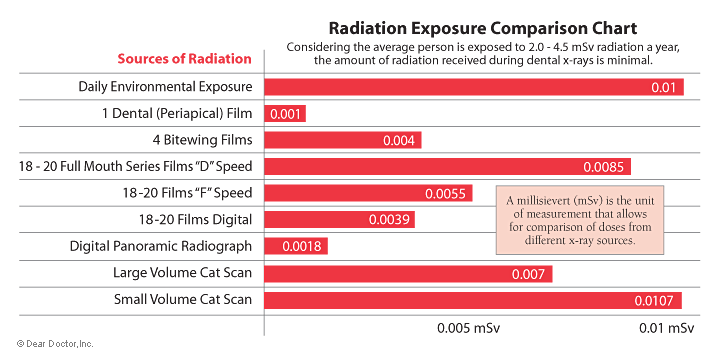
Below is a chart that illustrates exactly how little radiation is emitted from dental Xrays relative to activities in every day life. 


April 12, 2012   No Comments

March 22- World Water Day

March 22 is World Water Day and is the perfect opportunity to do your part to save precious H2O every day by making one simple change in your daily routine: Turn off the tap when you brush.

As a member of EcoDentistry association, you can pledge to do your part to save water at the link below! 

http://www.ecodentistry.org/?save90adaypublic

Thank you for doing your part!

March 8, 2012   No Comments

2012 Brings a new team member

Happy New Year 2012!  And a big welcome to our patient turned office administrator Tara!  She is a very welcome addition to our team, to help with patient care coordination as we grow.   Thank you for your referrals as we have had a year of many new patients in 2011.

January 6, 2012   No Comments

BPA Free Fillings!


Much uproar has surfaced about BPA or Bisphenol A, contained in plastics and in dental materials.

Baby bottles and other plastic bottles are notorious for containing the synthetic harmful substance that has been known to cause problems in the body (ie-certain reproductive cancers).  More specifically, BPA looks a lot like the hormone estrogen and can confuse the organs that produce or respond to the hormone.

In a time where we have recognized and moved beyond silver fillings due to their mercury content, white fillings are not without risk.  BPA is commonly used in most white (or composite) fillings.

In studies done approximately 10 years ago showed that BPA can be found in the saliva after 10 minutes of placing the filling.

Our team is very aware of this issue.   We have done our best to select dental composite fillings and dental sealants that don’t include bisphenol-A nor contain compounds that make bisphenol-A in the past, but  starting this week, we have switched our white filling material products to exclusively BPA free products.

We are proud to be of the first group of dentists on the east coast to make this change.  Please ask Dr Maria or our team for details.

June 21, 2011   4 Comments

News from the Eco Dentistry Asssociation

In yesterday’s email update from EDA, I found this interesting info.  Thought I’d pass it along to our patients!

We are proud members of the EDA! To read more, go to the  Eco Dentistry Association’s website

http://www.ecodentistry.org/

What are the benefits of digital x-rays? How often should my doctor take images?

Digital images are an important part of early detection. Diagnosing tooth decay, periodontal disease, or structural issues early means treatment can be less invasive and less costly. Frequency of digital imaging can vary, but “bitewing” images every six months and “full mouth x-rays” at a first exam and then every 5 years is a good standard of care.

Traditional x-rays result in significant waste and pollution.

They also expose the patient to higher levels of radiation. We are exposed to natural levels of radiation every day, but in the US, the average American’s annual dose of radiation has grown six-fold, as we use it to try to detect disease at its earliest stages. High doses of radiation can be toxic and are linked to cancer. With good reason, many patients are questioning the over-usage of medical x-rays, including dental x-rays.

Digital dental radiographs (x-rays) expose patients to 70-90% less radiation exposure than traditional dental x-rays.

You would have to take 20,000 digital dental x-rays to equal the radiation in one conventional mammogram, and you would have to take 100,000 digital dental x-rays to reach what is considered a maximum safe yearly dose of radiation. Flying round-trip coast-to-coast exposes you to 80x the radiation of a set of bitewing digital images.

In some cases, your dental professional will recommend a CBCT scan, which produces a three-dimensional image of the skull. These should be taken infrequently and only when diagnostically necessary. In many cases, a panoramic digital image is sufficient. CBCT scans may be used by an oral and maxillofacial surgery practice when other forms of imaging have been screened and a more complex level of diagnostics is involved.

In the case of implants, wisdom teeth removal, trauma, orthognathic surgery, a CBCT scan is often recommended and appropriate, and may improve the treatment outcome. Some CBCT scanning equipment will allow the dental professional to choose settings that lower radiation levels, and employ a pulse technology that produces less radiation than a continuous beam. The professional is also able to limit the area of radiation exposure to the specific area of interest.

When having any dental images taken, your provider should use a drape that blocks any radiation from your torso and neck. Many of these drapes contain lead, but new, equally effective models lead-free.

April 1, 2011   No Comments

Home from Honduras!

Jaymi-Lyn and Dr Maria are happy to be back to our families and patients!  Thank you San Marcos for another great year!  Check out this years photos in the mission trips section of our web page.

April 1, 2011   No Comments

Honduras Dental Mission Trip

Thursday March 3, Jaymi-Lyn and Dr Maria will return to San Marcos, where they met in 2009.  They will be part of a dental/medical team called Cape Cares, to provide services to the people of rural Honduras.  They are very excited to share stories and photos when they return!

March 1, 2011   No Comments

Digital Radiographs!

We are so excited to introduce digital radiography (xrays) to our practice!  Less radiation can now be used to produce an image of improved contrast to conventional radiography. Other advantages of digital include time saved and reduced impact on the environment through bypassing chemical processing.  Another advantage is the ability to digitally transfer and enhance images.

Digital Radiography  is essentially filmless X-ray image capture. In place of X-ray film, a digital image capture device is used to record the X-ray image and make it available as a digital file that can be presented for interpretation and saved as part of the patient’s medical record.

Look for this amazing addition to our practice the next time you visit!

January 8, 2011   No Comments

Additional Hours

We are happy to announce that we have added hours to our Monday schedule!  The hygienists will see patients starting at 7am instead of 10am on Mondays.  We will remain open until 7pm as usual.  These hours will take effect mid January 2011.

December 12, 2010   No Comments

Welcome Michele!

In November 2011, we were thrilled to welcome Michelle Palmer to our team! We searched high and low to find someone who we knew would make our patients feel comfortable, and is a great match for our team.  After weeks of searching, we found her!  Michelle has most recently worked in a care home as a director.  She is kind and warm, and we know our patients will find her extremely welcoming and helpful.   Michelle  lives near Worcester, Ma, and is the mother of three.

We wish Kathleen O’Connell all the best with her new role with the Board of Dentistry.  We thank her for many years of service to the practice!

December 12, 2010   No Comments